
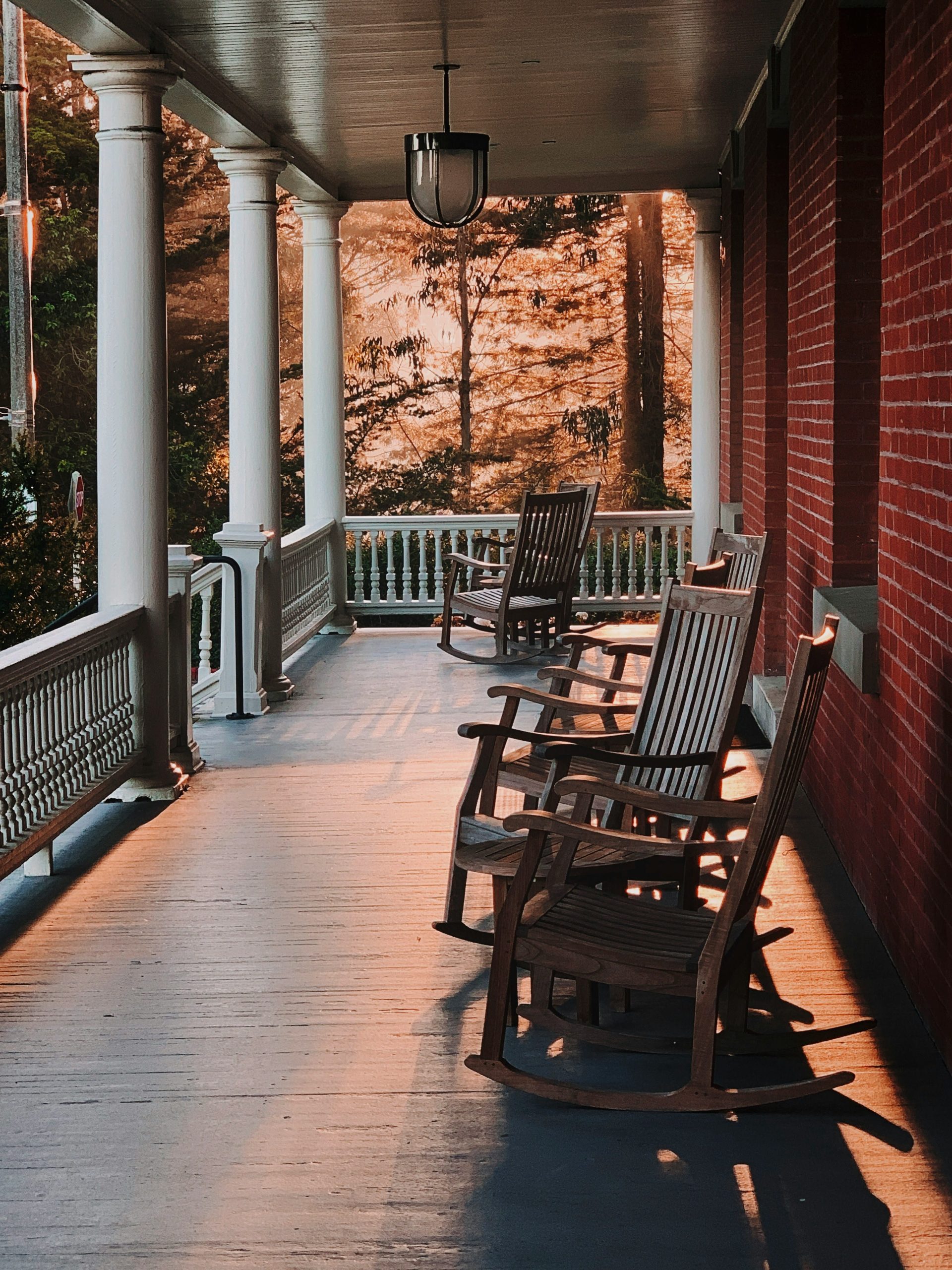
Front Porch Sitting: On the Act of Attention and the Art of Community Care (English and Spanish)
Oregon forests were the playground of my childhood, the place where I first remember walking from the safety of my front door down a wide and gravel-packed drive, past a handful of houses clustered together to the place where the bus would stop every morning just as the sun was beginning to edge over the tops of the trees, where the bifold glass doors would open and we would climb aboard, my brother, my sister, and I, and head off for the adventure of school, and return in the late afternoon as the sun was beginning to sink down past those same tree tops covered in damp green moss, and let us out again to return to our familiar family home.
The house had a porch, a wide wraparound affair that started by the front door and continued, unbroken around the side, under the soft sweeping branches of the firs and the redwoods, and finally extended the entire length of the back of the house, the wood planks covered in lichen and moss, the corners and crevices piled with pine needles and crumbling leaves and benches where I remember my great-grandmother sitting to watch us play when she came to visit the summer my younger sister was born, rough wooden seats where she rested her old bones while she kept an eye on the young children and kept us out of the way of the needs of a tired mother with a new baby.
That porch—and indeed, almost every porch—was a playground, a platform, a stage. A place to gather and play and party, a place where neighbors stood as they dropped off casseroles, a place where we pretended not to remember we had homework to do as we listened to adult conversation, a place where we sat in the dappled sun of a spring afternoon and told stories and whispered rumors and made up tales of what lived deeper in the woods past our house and past the neighbor’s house and past the little gathering of homes in the small town where we lived in the heart of the mountains in the middle of a patch of wild green.
This was, I think, the beginning of my fascination with the front porch. A single summer where that wrap-around deck became magic and mystery made of the loving ministration of a wrinkled old woman who cared enough to spend time winding wonderful tales to entertain small children when their mother could not.
If a house is a place where we learn to create a home, then a front porch is an in-between space, a borderland that lets us keep some things at arms length, but invite other things close, a place that is at once public and private, an area where we live not individual lives, but communal ones, open to the observation of those who happen to be walking or running or driving by, or perhaps sitting on their own front porch across the yard, or across the fence, or across the street as they observe us in return.
The history of the front porch is long and varied and deeply rooted in the global south, deeply rooted in communities that were physically close, that depended on one another, communities where the climates were too warm for sitting inside stifling rooms with the windows closed and the draperies drawn, where the only way to catch a hint of the stirring air, the respite of a breeze, the slightest cooling caress of currents over hot and sticky skin was to sit outside, in the shade of a portico or porch or veranda, safely out of the direct sun but open to the elements and where the survival of the people depended not only on their ability to cope with the harsh heat but on their ability to come together and create sustainable solutions to community-wide challenges. On their ability to watch out for stumbling steps along the sidewalks, to notice those who get home too late, or leave too early, to keep an eye on children, to carry packages, to render to one another a generous application of interest, service, and love.
My grandmother had a front porch, a few feet across the front of her small home, edged by a railing and a few potted geraniums and lined with wide flagstones that we loved to pick up and peer under, searching for pill bugs and spiders and other insects that are only interesting to children when they are young and bold with adventure in their hearts and dirt on their hands.
I remember her sitting there in a colorful cotton housedress with her gray hair braided in a crown around her head, her eyes wrinkled in soft delight, as she enjoyed the cooling air of a summer evening and talked to my parents, my aunts, my uncles, and all the cousins old enough for ‘adult’ conversation. As neighbors walked by they would pause, they would chat, they would check in with one another to find out how the crops were growing, to return an empty dish that had held cookies or cake or casseroles, to find out whose teenagers had gotten into what mischief, whose baby had a cold, who needed a meal, a hug, a helping hand. The crowd would grow larger, the laughter louder, food would be brought out, children would fall asleep in arms and on laps and tucked onto cushions in corners. These were not organized events. They were a part of everyday life—quick check-ins and concerned gossiping and informal status updates from the shelter of the front porch and the safety of the front garden. And it is, perhaps, these memories that have shaped my perception of the front porch as a feminine space, a maternal space, a nurturing space. It is a space where all are welcome, but one definitively ruled over by wise women—the aunties and grannies and widows who know everything there is to know about the world and don’t hesitate to share their opinions on it all.
Historically, the front porch was a site of endless hours of handwork—shelling peas, snapping beans, stitching quilt squares, knitting socks, mending clothes, all kinds of handcrafts worked while watching the world walk by, while keeping an eye on the children, while keeping a finger on the pulse of the community at large. My own experience is not one of peas (I have never quite liked that particular vegetable), but it does include a great deal of front porch sitting—of sweeping off the cement area by my front door, washing off the bench placed in just such a way that I can see the street and the nearest houses and the edge of the driveway, set so that I can watch for the comings and goings of my children, their friends, and my neighbors and my neighbor’s children as I enjoy the sun shifting in the sky overhead.
The porch is, of course, simply a metaphor. It is a symbol—one of communication, of trust, of safety. When we talk to one another, and get to know one another, and watch over one another, our neighborhoods grow more vibrant, and more secure, and more human. When we stand at our front doors and we see each other—in all our messy, bold, beautiful fallibility, complete with children running down the sidewalks and dogs barking at windows and fencelines and weeds growing in the corners of the yards between the petunias and the tomato plants, and drapes thrown open to let in the breeze and the sound of voices raised in laughter or hushed in grief—when we come out of isolation and become an essential part of a communal life we begin to see our streets and neighborhoods and even our earth differently. We are not striving for only our own gain, but we are caring, together. We are sharing the burden and privilege of love, and isn’t that such a very human thing to do?
If the front porch is a metaphor, it is one that serves a very important purpose. One that asks us to carefully consider not only the architecture of the thing—the sturdy pillars holding up a shingled shelter, the truss, the rafter, the beam, or the solid surface of the floor made of carefully laid bricks or wide sanded boards or carefully poured concrete, or even a flat and open simple space of raked dirt or pea gravel or paving stones, large enough for a chair or a bench or a swing, perhaps even a stump of a log left over after chopping down an old tree that used to grow on the lot next door—but also the less concrete aspects of it, the whys and wherefores and hows of becoming a part of a place, of living in a space not beside others but with them.
Our success—our joy and our satisfaction and our livelihoods—are not individual things that we can do in isolation. It is something built by the effort of many hands, all lifting together. The frontier image of the barn raising is more truth than pretty myth. And that truth—that we cannot succeed alone—asks us to look at what part we play. What contributions we make. What skills and knowledge and resources we have to give.
I believe we are all in this particular place for a purpose, and that a front porch can be a place or point from which we discover just what that reason might be. The beautiful thing about a porch, I have found, is that I am never outside for long before my neighbor stops to chat, before I see a dog walk by, before a car drives down the road and stops to roll down the window and someone I have not seen in all the long cold winter pauses to ask a question or simply to talk for a moment before they head out for the night.
When did the front porch begin to disappear? When did we retreat inside, each confined to our own spaces, with no care for what was happening outside our front doors? When did we begin to isolate ourselves, not only emotionally but physically, shutting our windows, drawing our blinds, and closing our doors? It feels like this change has come about gradually, and concurrent with challenges like loneliness, and solitude, and a fracturing of our community ties—and I can’t help but think they must be connected.
When I investigate community care and mutual aid, I have been surprised by the types of actions that are suggested for those looking to build stronger communities. An incomplete list: get to know your neighbors, socialize with those who live nearby, share childcare duties, care for the seniors and the widows and the young, watch out for strangers, garden together, teach one another new skills such as baking sewing and gardening, share the fruits of your labors such as excess food items, garden items, clothing items, and hygiene items, walk or exercise together, share chores, share knowledge, share books, share conversation, share entertainment and recreation. It might have been this last that made me stop and think, for all too often when trying to change the world we forget leisure and joy and the recreational aspect of living, but what else is play and pleasure if not a re-creation, and how truly, vitally important is creating in a world driven by consumption?
We know what this type of change looks like.
It looks like friends sitting on a front porch together, one busy rocking a baby and the other sewing a costume for an elementary school play, or reading a book out loud, or talking about the new family who moved in down the block, or planning the rides for the afternoon or the meals for the week. It looks like slowing down and learning to see the way the world moves in mad currents around us, and trying to pick each other out of the undertow before we choke and drown. It looks like work—but it also looks like fun, and I wonder if that is part of the problem, I wonder if we have come to think all important work has to be difficult, and I wonder about the work of caring because I believe it should be anything but unpleasant and painful.
It has become all too rare to see someone sitting outside, enjoying the air, waiting for something interesting to happen or someone new to walk by, and this, too, makes me wonder—how much do we miss, when we forget to slow down and look around? If we were to take our projects out in the fresh air and watch our neighbors walk by—what might we discover? What might we learn? What might we find ourselves capable of doing? And how do we correct this lack? How do we shift our focus back to habits that were once the very foundation of our community’s existence? How do we recreate customs that our ancestors took for granted and that we barely remember? It seems to me that our connection has to become more important than our discomfort, our community more important than our individuality, our labor more important than our isolation and ease.
You see, we have always known how to do the work—we’ve simply forgotten what it looks like. We’ve forgotten the front doors and the porches and the drives and walks and yards. We’ve forgotten the wide expanse of spaces that we used to share, where each individual enters a communal, collaborative community, where we become something more together than we could ever become alone. And because we have forgotten, we have simply shrugged and stopped building those spaces.
We stopped building porches that look out over our streets with the intent not to surveil but to nurture. We stopped shaping our homes and our outdoor spaces and our gardens around sharing our lives with others. We no longer ask people to stop and chat, to sit a spell, to share the casual kindness of a good conversation and a bit of gossip and a wrapped-up parcel of cookies or cake or recently picked veggies fresh from the ground.
But we’ve always known how to do this work. It is nothing new. Nothing radical. Nothing really revolutionary. It is meant to be easy, and it is meant to be fun, and it is meant to be a rewarding part of this whole messy, majestic experience of being human. Maybe that is what makes it so radical. It’s a radical act, after all, this business of stepping out our doors—even to simply sit on our own front porch.
Lead Photo Credit: Jon Tyson via Unsplash
En Español:
Traducido por Jessica Yanez Barker
Sentarse en el porche delantero: sobre el acto de prestar atención y el arte del cuidado comunitario
Los bosques de Oregón fueron el patio de juegos de mi infancia, el lugar donde recuerdo por primera vez caminar desde la seguridad de mi puerta principal por un camino ancho cubierto de grava, pasando por un puñado de casas agrupadas hasta el lugar donde el autobús se detenía cada mañana justo cuando el sol comenzaba a asomarse por encima de las copas de los árboles, donde las puertas de vidrio plegables se abrían y subíamos a bordo, mi hermano, mi hermana y yo, para emprender la aventura de la escuela, y regresar por la tarde cuando el sol comenzaba a hundirse detrás de esas mismas copas cubiertas de musgo verde húmedo, y dejarnos nuevamente para volver a nuestro familiar hogar.
La casa tenía un porche, una amplia estructura envolvente que comenzaba en la puerta principal y continuaba sin interrupción alrededor del costado, bajo las suaves ramas de los abetos y las secuoyas, y finalmente se extendía a lo largo de toda la parte trasera de la casa, las tablas de madera cubiertas de líquenes y musgo, las esquinas y grietas llenas de agujas de pino y hojas desmoronadas, y bancos donde recuerdo a mi bisabuela sentada observándonos jugar cuando vino de visita el verano en que nació mi hermana menor, asientos de madera tosca donde descansaba sus viejos huesos mientras vigilaba a los niños pequeños y nos mantenía fuera del camino de las necesidades de una madre cansada con un bebé nuevo.
Ese porche —y, de hecho, casi cualquier porche— era un patio de juegos, una plataforma, un escenario. Un lugar para reunirse, jugar y celebrar; un lugar donde los vecinos se detenían al dejar cazuelas; un lugar donde fingíamos no recordar que teníamos tarea mientras escuchábamos conversaciones de adultos; un lugar donde nos sentábamos bajo el sol moteado de una tarde de primavera y contábamos historias, susurrábamos rumores e inventábamos relatos sobre lo que vivía más adentro del bosque, más allá de nuestra casa, más allá de la casa del vecino y más allá del pequeño grupo de hogares en el pequeño pueblo donde vivíamos en el corazón de las montañas, en medio de un parche de verde salvaje.
Creo que este fue el comienzo de mi fascinación por el porche delantero. Un solo verano en el que esa terraza envolvente se convirtió en magia y misterio, hecha de la amorosa dedicación de una anciana arrugada que se preocupaba lo suficiente como para pasar tiempo tejiendo maravillosos cuentos para entretener a los niños pequeños cuando su madre no podía hacerlo.
Si una casa es un lugar donde aprendemos a crear un hogar, entonces un porche delantero es un espacio intermedio, una tierra fronteriza que nos permite mantener algunas cosas a distancia, pero invitar otras más cerca; un lugar que es a la vez público y privado, un área donde no vivimos vidas individuales, sino comunitarias, abiertas a la observación de quienes pasan caminando, corriendo o conduciendo, o quizás sentados en su propio porche al otro lado del jardín, o al otro lado de la cerca, o al otro lado de la calle mientras nos observan a su vez.
La historia del porche delantero es larga, variada y profundamente arraigada en el sur global, profundamente arraigada en comunidades que estaban físicamente cerca, que dependían unas de otras, comunidades donde los climas eran demasiado cálidos para sentarse dentro de habitaciones sofocantes con las ventanas cerradas y las cortinas corridas, donde la única manera de captar un indicio de aire en movimiento, el alivio de una brisa, la más leve caricia refrescante sobre la piel caliente y pegajosa era sentarse afuera, a la sombra de un pórtico o porche o veranda, a salvo del sol directo pero abiertas a los elementos, y donde la supervivencia de las personas dependía no solo de su capacidad para sobrellevar el calor intenso, sino de su capacidad para unirse y crear soluciones sostenibles a los desafíos comunitarios. De su capacidad para vigilar los pasos vacilantes en las aceras, notar a quienes llegan demasiado tarde o salen demasiado temprano, mantener un ojo en los niños, cargar paquetes y brindarse mutuamente una generosa aplicación de interés, servicio y amor.
Mi abuela tenía un porche delantero, unos cuantos pies a lo largo del frente de su pequeña casa, bordeado por una barandilla y algunos geranios en macetas, y cubierto de losas anchas de piedra que nos encantaba levantar para mirar debajo, buscando cochinillas, arañas y otros insectos que solo resultan interesantes para los niños cuando son pequeños y valientes, con aventura en el corazón y tierra en las manos.
La recuerdo sentada allí con un vestido de algodón colorido, su cabello gris trenzado en una corona alrededor de la cabeza, los ojos arrugados de suave alegría mientras disfrutaba del aire fresco de una tarde de verano y conversaba con mis padres, mis tías, mis tíos y todos los primos lo suficientemente grandes para participar en conversaciones “de adultos”. Cuando los vecinos pasaban, se detenían, charlaban, se ponían al día para saber cómo iban los cultivos, devolvían un plato vacío que había contenido galletas, pastel o cazuelas, averiguaban qué adolescentes se habían metido en qué travesuras, qué bebé tenía un resfriado, quién necesitaba una comida, un abrazo, una mano amiga. El grupo crecía, las risas aumentaban, la comida salía, los niños se dormían en brazos, en regazos o acomodados sobre cojines en los rincones. No eran eventos organizados. Eran parte de la vida cotidiana: rápidas visitas, chismes preocupados y actualizaciones informales desde el refugio del porche delantero y la seguridad del jardín frontal. Y son, quizá, estos recuerdos los que han moldeado mi percepción del porche delantero como un espacio femenino, un espacio maternal, un espacio de cuidado. Es un espacio donde todos son bienvenidos, pero definitivamente gobernado por mujeres sabias —las tías, las abuelas, las viudas que saben todo lo que hay que saber del mundo y no dudan en compartir sus opiniones sobre todo.
Históricamente, el porche delantero fue un lugar de interminables horas de trabajo manual: desgranar guisantes, partir ejotes, coser cuadros de colchas, tejer calcetines, remendar ropa, todo tipo de artesanías hechas mientras se observaba al mundo pasar, mientras se vigilaba a los niños, mientras se mantenía un dedo sobre el pulso de la comunidad en general. Mi propia experiencia no incluye guisantes (nunca me ha gustado mucho ese vegetal), pero sí incluye una gran cantidad de tiempo sentada en el porche delantero: barrer el área de cemento junto a mi puerta, lavar el banco colocado de tal manera que puedo ver la calle, las casas más cercanas y el borde de la entrada, dispuesto para poder observar las idas y venidas de mis hijos, sus amigos, mis vecinos y los hijos de mis vecinos mientras disfruto del sol moviéndose en el cielo.
El porche es, por supuesto, simplemente una metáfora. Es un símbolo: uno de comunicación, de confianza, de seguridad. Cuando hablamos entre nosotros, cuando nos conocemos, cuando nos cuidamos mutuamente, nuestros vecindarios se vuelven más vibrantes, más seguros y más humanos. Cuando nos paramos en nuestras puertas delanteras y nos vemos unos a otros —en toda nuestra desordenada, valiente y hermosa falibilidad, con niños corriendo por las aceras, perros ladrando desde ventanas y cercas, malezas creciendo entre las petunias y las plantas de tomate, cortinas abiertas para dejar entrar la brisa y el sonido de voces que ríen o murmuran en duelo— cuando salimos de la soledad y nos convertimos en una parte esencial de una vida comunitaria, comenzamos a ver nuestras calles, nuestros vecindarios e incluso nuestra tierra de manera diferente. No buscamos solo nuestro propio beneficio, sino que cuidamos, juntas. Compartimos la carga y el privilegio del amor, ¿y no es eso algo profundamente humano?
Si el porche delantero es una metáfora, es una que cumple un propósito profundamente importante. Nos invita a considerar no solo la arquitectura física —los pilares firmes que sostienen un techo de tejas, la armadura, la viga, el piso sólido hecho de ladrillos colocados con cuidado, de tablas anchas lijadas, de concreto vertido con precisión, o incluso un espacio simple y abierto de tierra rastrillada, grava fina o losas de piedra, lo suficientemente amplio para una silla, un banco o un columpio, quizá incluso el tocón de un tronco que quedó tras talar un viejo árbol del terreno vecino— sino también los aspectos menos tangibles: los porqués, los cómos y los para qué de convertirnos en parte de un lugar, de vivir no junto a otros, sino con ellos.
Nuestra capacidad de prosperar —nuestra alegría, nuestra satisfacción, nuestro sustento— no es algo que podamos construir en aislamiento. Es algo que se levanta con el esfuerzo de muchas manos, todas levantando juntas. La imagen fronteriza de la construcción comunitaria de un granero es más verdad que mito. Y esa verdad —que no podemos tener éxito solas— nos invita a mirar qué papel desempeñamos. ¿Qué aportes hacemos? ¿Qué habilidades, conocimientos y recursos tenemos para ofrecer?
Creo que todas estamos en este lugar particular por un propósito, y que un porche delantero puede ser un punto desde el cual descubrimos cuál podría ser esa razón. Lo hermoso de un porche, he descubierto, es que nunca estoy afuera por mucho tiempo antes de que mi vecina se detenga a conversar, antes de ver pasar un perro, antes de que un auto avance por la calle y se detenga para bajar la ventana y alguien a quien no he visto en todo el largo invierno frío se tome un momento para hacer una pregunta o simplemente hablar un instante antes de seguir su camino.
¿Cuándo comenzó a desaparecer el porche delantero? ¿Cuándo nos replegamos hacia adentro, cada una confinada a su propio espacio, sin prestar atención a lo que ocurría fuera de nuestras puertas? ¿Cuándo empezamos a aislarnos, no solo emocionalmente sino físicamente, cerrando ventanas, bajando persianas y echando cerrojos? Parece que este cambio llegó poco a poco, acompañado de desafíos como la soledad, el aislamiento y la fractura de los lazos comunitarios —y no puedo evitar pensar que deben estar conectados.
Al investigar sobre el cuidado comunitario y la ayuda mutua, me ha sorprendido el tipo de acciones que se sugieren para quienes desean construir comunidades más fuertes. Una lista incompleta: conocer a tus vecinos, socializar con quienes viven cerca, compartir el cuidado de los niños, cuidar a los ancianos, a las viudas y a los jóvenes, vigilar a los desconocidos, cultivar juntas, enseñarse mutuamente nuevas habilidades como hornear, coser o sembrar, compartir los frutos del trabajo —alimentos, productos del jardín, ropa, artículos de higiene— caminar o hacer ejercicio juntas, compartir tareas, compartir conocimientos, compartir libros, compartir conversación, compartir entretenimiento y recreación. Quizá fue este último punto el que me hizo detenerme a pensar, porque con demasiada frecuencia, cuando intentamos cambiar el mundo, olvidamos el ocio, la alegría y el aspecto recreativo de vivir. Pero ¿qué es el juego y el placer sino una recreación? Y ¿qué tan esencial, vitalmente esencial, es crear en un mundo impulsado por el consumo?
Sabemos cómo se ve este tipo de cambio.
Se ve como amigas sentadas juntas en un porche delantero, una meciendo a un bebé y la otra cosiendo un disfraz para una obra escolar, o leyendo un libro en voz alta, o hablando sobre la nueva familia que se mudó a la vuelta de la esquina, o planificando los traslados de la tarde o las comidas de la semana. Se ve como desacelerar y aprender a observar cómo el mundo se mueve en corrientes frenéticas a nuestro alrededor, e intentar rescatarnos mutuamente del remolino antes de que nos ahoguemos. Se ve como trabajo… pero también se ve como diversión, y me pregunto si esa es parte del problema, si hemos llegado a pensar que todo trabajo importante debe ser difícil, y me pregunto sobre el trabajo de cuidar, porque creo que debería ser cualquier cosa menos desagradable o doloroso.
Hoy es demasiado raro ver a alguien sentado afuera, disfrutando del aire, esperando que ocurra algo interesante o que pase alguien nuevo, y esto también me hace preguntarme: ¿cuánto nos perdemos cuando olvidamos desacelerar y mirar alrededor? Si sacáramos nuestros proyectos al aire libre y observáramos a nuestros vecinos pasar, ¿qué podríamos descubrir? ¿Qué podríamos aprender? ¿De qué podríamos encontrarnos capaces? ¿Y cómo corregimos esta carencia? ¿Cómo volvemos a enfocarnos en hábitos que alguna vez fueron la base misma de la existencia de nuestras comunidades? ¿Cómo recreamos costumbres que nuestras antepasadas daban por sentadas y que hoy apenas recordamos? Me parece que nuestra conexión debe volverse más importante que nuestra incomodidad, nuestra comunidad más importante que nuestra individualidad, nuestro esfuerzo más importante que nuestro aislamiento y comodidad.
Verás, siempre hemos sabido cómo hacer este trabajo; simplemente hemos olvidado cómo se ve. Hemos olvidado las puertas delanteras y los porches y los caminos y los jardines. Hemos olvidado la amplia extensión de espacios que solíamos compartir, donde cada individuo entra en una comunidad colaborativa, donde juntas nos convertimos en algo más de lo que jamás podríamos ser solas. Y porque lo hemos olvidado, simplemente hemos dejado de construir esos espacios.
Dejamos de construir porches que miran hacia nuestras calles con la intención no de vigilar, sino de nutrir. Dejamos de diseñar nuestros hogares, nuestros espacios exteriores y nuestros jardines alrededor de la idea de compartir la vida con otros. Ya no invitamos a la gente a detenerse y conversar, a sentarse un rato, a compartir la amabilidad casual de una buena conversación, un poco de chisme y un paquete de galletas, pastel o verduras recién cosechadas.
Pero siempre hemos sabido cómo hacer este trabajo. No es nada nuevo. Nada radical. Nada realmente revolucionario. Está destinado a ser fácil, y está destinado a ser divertido, y está destinado a ser una parte gratificante de toda esta experiencia desordenada y majestuosa de ser humanos. Quizá eso es lo que lo hace tan radical. Después de todo, es un acto radical este asunto de salir por nuestra puerta… incluso si es solo para sentarnos en nuestro propio porche delantero.

Shelli is an advocacy writer and creative writing teacher. She loves to spend time with her husband (usually in the garden) and their four almost adult children. She also loves to sew (usually for the local community theater), to read, to write, and to drag her family outside to look at the sky. Shelli is passionate about poetry, Broadway show tunes, and telling stories -- of ourselves, our families, and our communities.
View Author PageStay Inspired
Join Our Newsletter Journey
Dive deeper into the world of Big Ocean Women. By subscribing to our newsletter, you'll receive a monthly dose of empowering stories, insightful articles, and the latest news from our global sisterhood. Don't miss out on the wave of inspiration – subscribe now and be part of our ever-growing community.