

Broadening My Perspective on Maternal Feminism
“Maternal feminism looks at a deeper issue: what if men and women realized the importance of a child in this world and were able to balance, in an equal manner, taking into account physiological differences, such as pregnancy, childbirth and breastfeeding, the responsibilities towards children, the home and, consequently, towards the entire planet? How can companies, society and families organize themselves to take these discussions and models of reality forward?”
This desire to strengthen home and family by fortifying the interdependent bond husband and wife have as equal partners is not new in our generation. Brilliant minds have been wrestling with this issue, and so many related queries, for eons. Carla Machado’s heartfelt question reignites the discussion for me:
“How can companies, society and families organize themselves to take these discussions and models of reality forward?”
I don’t have an answer. But, thanks to Ken Wilbur, Robert Kegan, Terri O’Fallon, Thomas McConkie, and John Kesler, I am developing more as an adult, and my capacity to see more of the issue is growing. The work of each of these individuals promotes discussion and teaches theoretical models that broaden our mind about how we are thinking and challenge our vision about how we are seeing.
Perhaps our progress individually and collectively lies not in different solutions but in different ways of thinking and seeing the issue of maternal feminism.
Ken Wilbur teaches a four-quadrant model that helps me differentiate in my mind the way I see and think about maternal feminism. Wilbur identifies the individual and collective perspectives and the inner (belief) and outer (behavior) worlds.
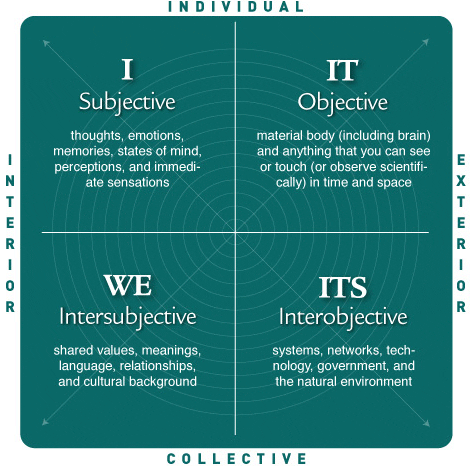
He insists that our thinking and our solutions often focus on only one or two quadrants, which is why we are still struggling to make effective, lasting change. I see the application here for my wrestle personally with my narrative of maternal feminism.
My Individual Perspective
As a divorced woman and single mom, I openly own that, despite a master’s degree in marriage, family, and human development, I struggled in my life to live out the ideal of an equal partnership. I also realize that my own inner beliefs about the value of my maternal and feminine contribution was warped. Sometimes I held back in a desire to please or fit in, and other times I led out strongly and felt alone. I did not feel confident in either side of that polarity.
Though it is sobering to admit these things in a public forum, I also celebrate the opportunity to be a part of a deliberately developmental solution, and that means showing up to the conversation fully acknowledging both my abilities and inabilities, my strengths and my weaknesses.
I’ve experienced profound growth in my personal identity and my mothering in the past two years. I am showing up more authentically and being more agency-supportive of my children in their development. I attribute this to my growth in conscious awareness and accountability for my inner and outer world as an individual. Integrating many polarities and finding the still point in my own soul allows me to show up with confidence in my feminine and maternal roles.
Our Collective Perspective
Looking at maternal feminism through a collective lens has been equally fruitful in my life. We are all an inseparable part of something bigger than ourselves. While this can be inspiring and promote connection and belonging, it can also be frustrating and at times disheartening. The institutions, cultures, and familial units that strengthen and anchor us can also disempower and bind us.
Collective beliefs and behaviors are much more challenging to change than those on the individual level. However, I’ve learned that as a part of the collective my positive voice and example can lead growth in a helpful direction.
For me, challenging collective traditions has not looked like protest or attack. It has meant learning to put down my metaphorical sword in favor of questions, conversations, and coaching that lead in the direction I believe we want to grow and develop as a collective. To use biblical terms,
“…and they shall beat their swords into plowshares, and their spears into pruning hooks: nation shall not lift up sword against nation, neither shall they learn war any more.” (Isaiah 2:4)
I have not spoken to thousands or changed collective policy, but I have been true in how I have engaged in the collective. In one specific interchange with a man in high authority in my religious organization, he asserted his plan for a course of action that I knew was neutralizing my authority in my personal stewardship. My heart started racing, and though my pulse was pounding in my ears, I kindly pushed back and opened an important conversation. In the end we each had clearer boundaries of the balance of authority between the institution and the individual. He left the conversation with gratitude to me for helping him “see a blind spot,” and I left with gratitude for being heard and respected. We continue to have positive interactions, and I believe that moment of courage strengthened the collective for both of us.
Conclusion
Albert Einstein once said,
“If I had an hour to solve a problem and my life depended on the solution, I would spend the first 55 minutes determining the proper question to ask…for once I know the proper question, I could solve the problem in less than five minutes.”
The complex issues of maternal feminism and balance between men and women are going to take more than five minutes to solve, but the principle is true that taking time to fully see the issue from many different angles changes how we show up to being part of the solution.
This approach may not bring overnight or global change, but it has helped to answer Machado’s question for me.“How can companies, society and families organize themselves to take these discussions and models of reality forward?”
I can organize my thinking and my vision to see the issues more clearly and claim my power, in belief and behavior, as an individual and part of a collective, to effect meaningful change.
Lead photo credit: National Cancer Institute via Unsplash

Emily Layton calls Ohio home. She delights in fireflies, autumn leaves, campfires, waterfalls, and M&Ms. The joy is doubled if she can enjoy any of these things barefoot or with family or friends. She is the mother of five, with two daughters-in-law and three darling grandchildren. Emily loves learning, growing, and seeking truth and recently started a podcast and coaching business to strengthen women in their identity development called Grow in the Light. She received a MS degree from Brigham Young University in Marriage and Family Studies, has published many articles as a qualitative scholar, and is a contributing author for the American Families of Faith Project.
View Author PageStay Inspired
Join Our Newsletter Journey
Dive deeper into the world of Big Ocean Women. By subscribing to our newsletter, you'll receive a monthly dose of empowering stories, insightful articles, and the latest news from our global sisterhood. Don't miss out on the wave of inspiration – subscribe now and be part of our ever-growing community.