
On Comets, Solar Storms, and Planetary Alignments: or, Another Essay about the Sky
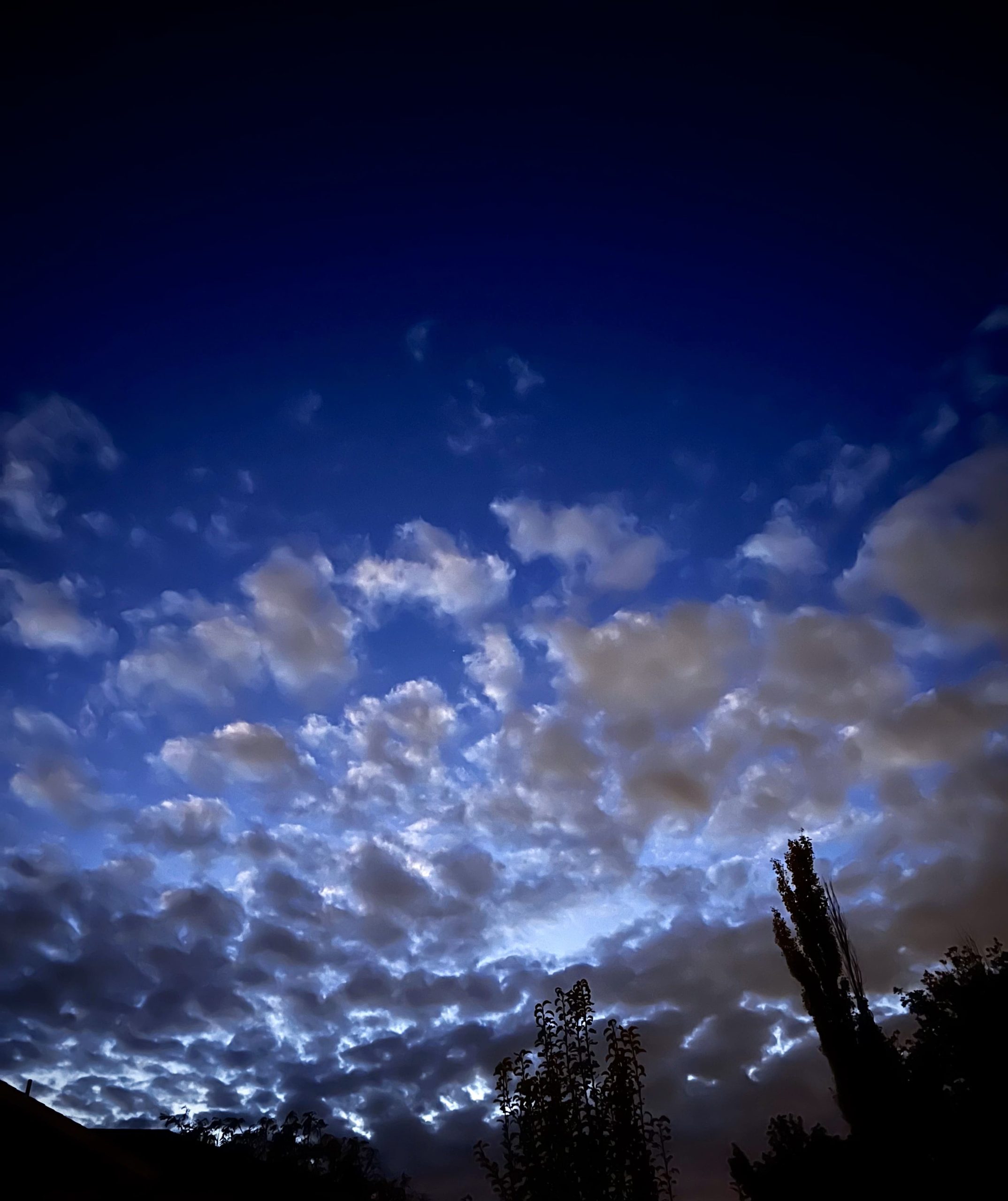
It is difficult to photograph the night sky. To adjust the length of exposure, to account for clouds and streetlights and airplanes. To track the movement of the stars or the changing shape of the moon. To capture on film something more than just a smudge of dim light against an endless field of black.
I keep trying.
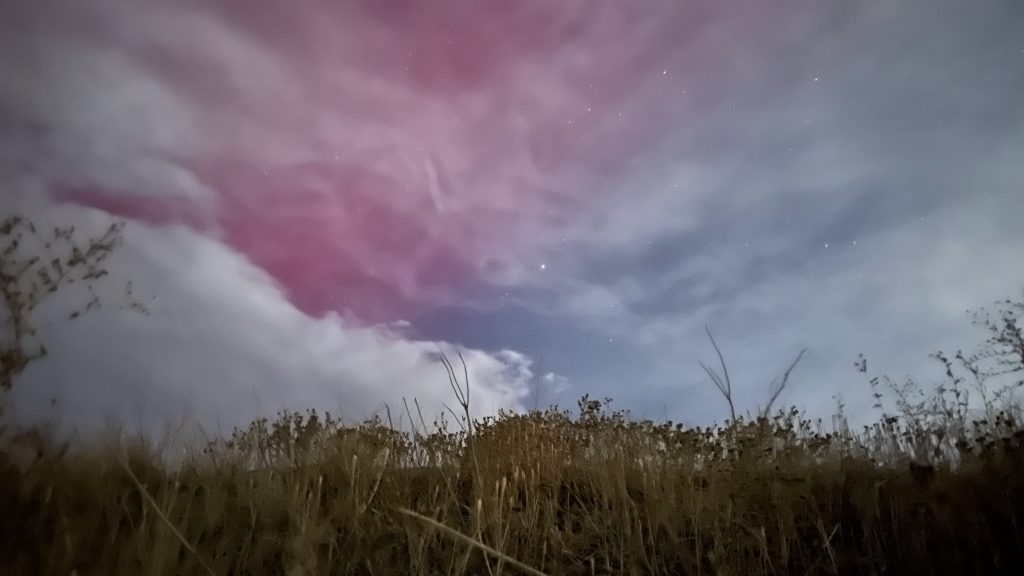
In the last few weeks there has been a veritable abundance of celestial events—solar geomagnetic storms that have caused the Aurora Borealis to be visible in places it rarely ever reaches, interesting planetary alignments that have clustered around the light of the full moon, and even a comet, traversing the night sky, moving through constellations on a journey with an undetermined destination. For each of these events we have sought a vantage point to watch from, my husband and I, and sometimes my kids, driving to a dark overlook that sits at the edge of a cemetery, on the side of one mountain range facing the west where you can look out at the lights of the city below, at the gleam of a wide lake that makes a dark void in the night black landscape, and eventually, far on the horizon, at the faint outline of another mountain range in the dim distance.
I’m not the only one fascinated by the heavens.
The first night at the outlook there were a handful of aurora chasers there—a young couple on foot, an older man on his bike, a middle aged couple in a low, white sedan. The second time there were even more, young families with kids, old couples, a few college students with blankets laid out on the grass—a completely different group of individuals hoping for a glimpse of the full moon and Neptune, or the long tail of the comet, or the last lingering traces of the pink and green aurora glow. It was practically crowded there on that hillside as we stood in the dark looking out at the spread of the horizon with all the wonders of the universe wheeling overhead.
It is easy, when faced with the wide expanse of the sky, to feel small. To be overwhelmed by the movement of worlds we will never fully see with our very limited human eyes, or even be able to fully imagine. But it has never made me feel diminished or dwarfed. Instead, I feel an immense amount of hope. I take from the experience a sense that the beautiful, the mysterious, and the awe inspiring things in this world are endless and eternal, and that I can have some part in them—even if that part is to be an appreciative viewer, marking moments of joyful wonder.
I suppose my love of the sky might be traced to growing up in rural towns in Oregon and California, places where there were no streetlights, no city lights, no neighborhood lights, really, to interfere with an unimpeded view of the whole of the milky way wheeling overhead on a clear moonless night.
Or it might have begun with long evenings in my teens spent with Star Wars, and Star Trek, and Doctor Who, or any classic movie or TV show in which the main character adventures among the cosmos—all of the shows slightly nerdy or geeky, but full of new adventures and interesting ideas. It was transformative, those stories full of heroes and mentors and villains, of challenges overcome and difficulties yet to be faced, all wrapped up neatly at the end of an hour in success and celebration for the worthy. For a slightly awkward adolescent it was inspiring.
And a lot of fun.
There is a line from the newest reboot of the science fiction classic Doctor Who that I think about a lot. The Doctor asks about a girl that has caught his interest, and is brushed off with the response “Oh, her? She’s nobody important,” to which he replies, “Blimey, that’s amazing. You know in nine hundred years of time and space I’ve never met anyone who wasn’t important before.”
It feels like an almost revolutionary thought. That each one of us is important. That we have value that is intrinsic. That we matter, all of us, no matter the journeys we have embarked on—that in the grand scheme of things we are all a very small light streaking across an immense dark sky—but that someone, somewhere, might be watching us, rapt, as we journey on out of their view.
Isn’t that amazing?
Here is the thing I think we forget—those comets are just ice and rocks and dirt, the aurora borealis is simply energy made visible as it reaches the earth’s atmosphere, the convergence of planets is only one part of a larger journey that will continue for far longer than the time we have on this earth. All of these events, these miracles and marvels are, at their heart, ordinary. Just like us.
We are all an amalgamation of different times and places and purposes, of different points of view, the result of standing in different places and seeing different things when we look out over the world.
Isn’t it wonderful?
We are made up of stardust, yes, but also of little moments and big conversations and long drives and short walks and slow cold nights and summer days that are over too quickly, and there is no easy way to quantify our lives, or our influence.
We need to be reminded that we each have small parts in larger adventures—that there is a great and glittering cosmos overhead, that the earth is turning and the stars blinking and the comets are moving through space, and that while we may not have much influence over gravitational pull, we have a great deal to do with the rest of it—that every individual matters as we try to make our story a better one, as we change and influence what we can with our plain and precious time.
Isn’t it marvelous?
Looking at the sky reminds me that our limited lives are both small as well as vastly important. It reminds me that we are one tiny part of an endless adventure. It reminds me of goals I sometimes think of as unreachable as well as ambitions I have already achieved.
It is true that in a normal life we sometimes lose sight of the big picture. Interruptions become habitual, as we lean in towards those who need care and caretaking, putting aside our other callings for what is, in the moment, the most urgent, the most compelling, the most important, and it is sometimes much later before we are able to return, to circle around and attempt to pick up the dropped threads, the abandoned tasks, to turn ourselves from the nurturing of others to the nurturing of our own work, except that is wrong, really.
That point of view takes what is a blessing and situates it as a burden. I am so thankful for the interruptions in my life—for the people who demand more of me than I thought possible. So much of what I have come to believe has been shaped by the tasks that I might have avoided if possible. The author Tillie Olsen once said, when talking about what kept her from her chosen passion of writing, that “too much of life enters into this house,” and I think she meant it as a criticism, as some sort of commentary on distraction and deferral and delay, but to me, the very idea is beautiful.
Too much of life enters into our homes. Isn’t that fantastic?
Too much living, too much talking and planning and feeding and driving and counseling and waiting, too much caring and helping and serving. And in the living we need to remember that we are each of us important. We need to see in the dull dust of our ordinary living the seeds of stardust. To believe otherwise is foolish. Like looking up at noon on a bright summer’s day and failing to see the sun.
We also need to remember that while we are each individually important, we are not alone. We are surrounded by others—other stars in other constellations, or other stargazers who come to stare at the skies in wonder and awe—other humans who we work beside, who we care for, who we are entangled with for the whole of the living of every night and every day. Near the end of the Hobbit, Gandalf reminds Bilbo that “You are only quite a little fellow in a wide world, after all,” to which Bilbo replies, “Thank Goodness.”
Thank goodness we are all together on this adventure of late nights and early mornings and star gazing and care taking and connecting and communing with other sky watchers, with others who realize the importance of our lovely small impact on the very large world.
Thank goodness we are not alone, standing on some cold and windy hillside, looking up at the wide universe above us, made to feel isolated, small, or insignificant.
Thank goodness for our own part in the turning of the world, no matter how small.
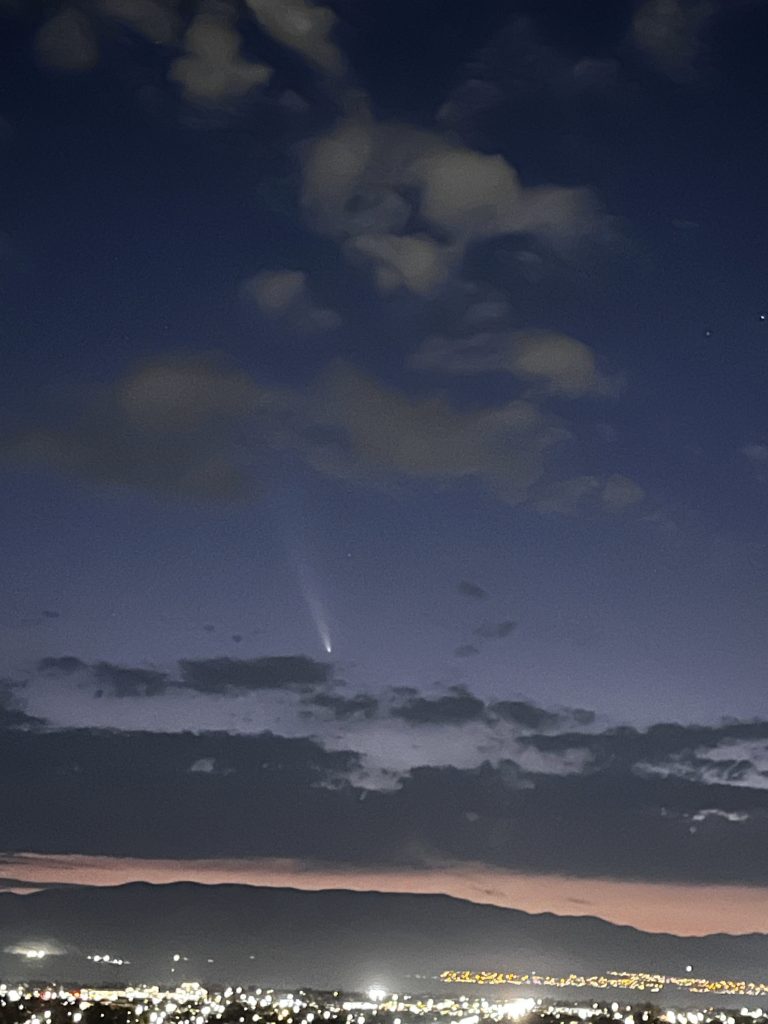
I could not help thinking—in the long run, did it matter if I was standing there on that hill last week to watch that particular comet pass us by? For the comet did not notice me there—I was not a vital part of the event, of the movement of the stars and the rotation of the earth. The comet itself would have continued on its way, even if it had been hidden by clouds, even if I had gone to bed early, even if I were not standing in the grass with my cell phone in hand, trying to get a lucky shot as it streaked across the sky.
But it mattered to me. Piling into the car with my husband and grown children and three dogs, driving the distance to get to an overlook where we could see without the pollution of lights, far above the noise, and above the streetlamps, and above the passing headlights and the glare of porch lights. It took time. It took effort. It forced us into the close confines of our car to talk and laugh and speculate. It left us standing together in the dark on a mostly cloudy night, anxiously searching the dark blue/black of the sky for something bigger and brighter than ourselves. It reminded me that sometimes memories need to be consciously made. That adventures need to be sought out. That we sometimes need something larger than ourselves to remind us how much our lives and our stories matter as we tracked the tails of comets trailing overhead, or the soft glow of the northern lights on the far edge of the horizon.
It reminded me that although we are only little fellows in a great wide world, we are also somebody important.
Isn’t it wonderful?

Shelli is an advocacy writer and creative writing teacher. She loves to spend time with her husband (usually in the garden) and their four almost adult children. She also loves to sew (usually for the local community theater), to read, to write, and to drag her family outside to look at the sky. Shelli is passionate about poetry, Broadway show tunes, and telling stories -- of ourselves, our families, and our communities.
View Author PageStay Inspired
Join Our Newsletter Journey
Dive deeper into the world of Big Ocean Women. By subscribing to our newsletter, you'll receive a monthly dose of empowering stories, insightful articles, and the latest news from our global sisterhood. Don't miss out on the wave of inspiration – subscribe now and be part of our ever-growing community.