

The Shelter of our Wild Wilderness
Photo Credit: Jeffrey Eisen via Unsplash
There is a waterfall not far from my home, a wild and white cascade of water over/under/around a tumble of rocks, water that falls like a spray of white lilies, like flower petals thrown into the wind, like snow, or like the gauzy white fabric of the bridal veil it was named for, a series of them, one after another, slipping over sudden cliffs and edges that sends the water falling into space and breaking apart, and what was once a river upstream becomes individual drops twisting, tumbling, tilting through the air to plunge into a shallow pool far below in a haze of mist that smells green, that carries the aroma of new plants in warm soil and the bite of bright mornings and the sense of jackets thrown over shoulders as protection against the chill of early spring.
There is a river, not far from my home, where my son goes to fish, a slow-moving amble of water that is dark in some spots, deep and still and replete with fish, he thinks, he hopes, he believes as he casts his line into the water over and over again hoping for a nibble, a bite, a nudge, and those are the spots he looks for when he sets off for the day with his gear and his rods and his long, rubber overalls that are secured into galoshes meant for standing in cold water for hours at a time, but it is a long river, with many turns and curves and drop-offs and so it is not always dark, but in some places it is shallow, and bright with glints of green and gold and silver and the flash of sun on the surface and so clear it looks like you can reach in and touch the bottom, which I do not recommend unless you have a change of clothes handy because the water is deceptive and the water is cold and I always end up wetter than I meant to, I always end up shivering in the shade-dappled sun.
There is a mountain, not far from my home, the shattered slipshod surface of what experts tell me is limestone and dolomite and shale, but to me it looks like gray and tan and black, an uneven face that climbs into cliffs and canyons and caves and provides a backdrop for viewing and a landscape for hiking, and meadows and paths and rivers for wandering and fishing and picnicking, and outcroppings where my brother-in-law tells me he sees bighorn sheep and deer and foxes and elk and even, once, a cougar, which is fantastic and fantastical and vaguely terrifying and hard for me to imagine since all I can see without the help of my glasses, which I sometimes forget to wear, and sometimes even with their aid, since prescriptions are difficult and glass gets smudged and fingerprints are hard to see through, are shapes and blocks of color—grays and browns and greens and the triangular spires of pine trees and the dull ash of scrub oak and sometimes bright spots of yellow that might be wildflowers or might be grasses or might be birds.
There is a cave not far from my home, up a steep and winding path, over the top of the tree line, in a dark crevice in the stone that comes from the heart of the mountain where I have hiked in the past, although it is steep and it is long and it is hot and strangely void of shade on the way up which makes it too sunny in the summer and too icy in the winter and the brief moments in between are often gone and faded before I realize it, and in that cave is a landscape as alien as the moon, red and black and pink stalactites and stalagmites and weird, twisting outcroppings of rock that were discovered when some trapper wandered, lost, over the mountain in the days when beaver swam in the rivers, before they moved on, before they were caught, captured, and cleared from the land, and I wonder sometimes if it is invasive, to visit the inside of what was meant to be seen from outside, a place never intended to be walked on, to be seen, to be touched by curious, grasping hands.
I live my life in close proximity to this kind of wild beauty, often forgetting what it looks like as I peer at the world through screens and pages and secondhand stories. This landscape, this place I live, this wilderness on the edge of suburban sprawl and city creep and housing developments and shopping centers, this wild, it is written into the lives of my mother’s mother’s mothers, and into the stories my children tell my husband and me when we gather around the table at night, and into my very bones. In these places around my home I have come to many realizations as I have walked down trails (because going down is always preferable to climbing up), under old bridges below new roads, and over stones that carry the echoes of the past, from both explorers that wandered far before I knew the world and the schoolchildren that wandered shrieking down the path just the day before, dropping unwanted bits of trail mix on their way, a bread crumb trail of raisins and Brazil nuts and dried, withered fruit (but never the chocolate; they always seem to eat the chocolate).
This is what I have learned.
The wild encourages community. It is dangerous, after all, to step outside one’s front door. It is hazardous to go alone. Better to take a friend to travel with. Better yet, a group. After all, as my son tells me with a glint of laughter in his eye, you don’t have to be fast to escape danger, just faster than your slowest companion. And it takes effort to forge new trails. Effort and the prints of a thousand feet. Best to get started right away.
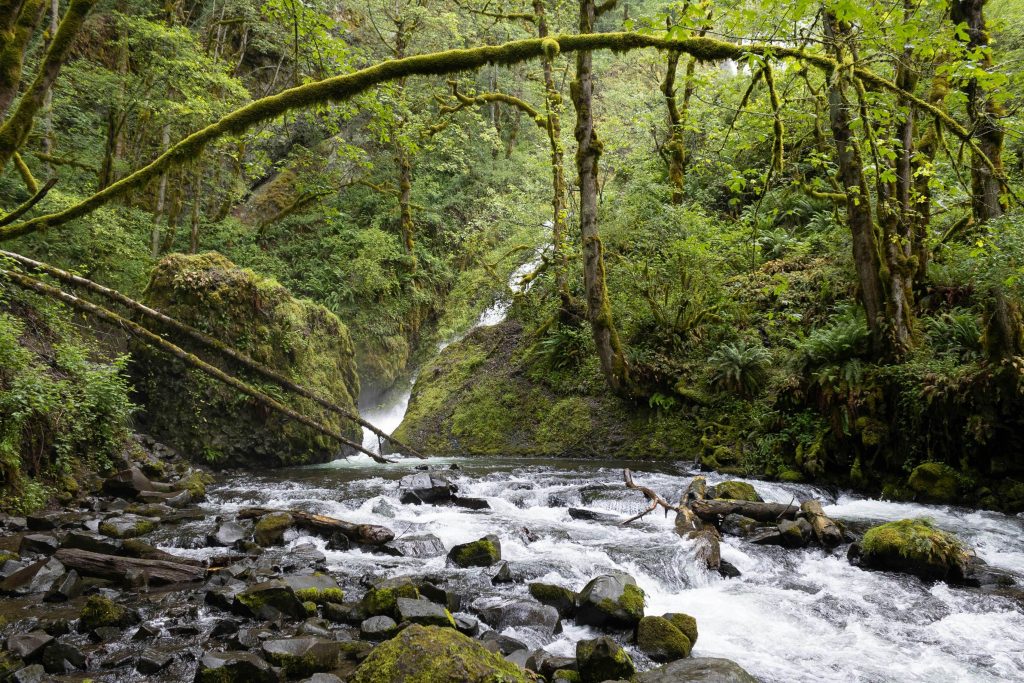 Photo Credit: Leslie Cross via Unsplash
The wild encourages curiosity. I was raised on stories of the wilderness. Stories of pioneers and pilgrims and ancestors homesteading their way through brave new worlds. It took me a long time to find that we still live in this same wilderness—we simply forget to look outside our door. There is a scene in my memory, clear despite the passing years, even if it is somewhat faded at the edges, like a photograph left out in the sun, like a film made decades ago and now edged with sepia tones, and it is this. A clear summer sky, blue with a few wispy clouds. A sparkling river at the bottom of a steep gorge. A wobbling rope bridge. And my father, carrying long boards over that bridge, one by one, as I watched, as my mother watched, as my brother and sister watched, each board making up the pieces to a bunk bed that he would take home and put together in my room, a bed much more stable than the swinging of the bridge he used to bring them across the ravine, and I have a lot of questions about this memory, questions I have asked my father like where we were (in the middle of a forest of old growth trees in the southern part of Oregon near the mountains near the sea), and why a bunk bed (because there were two adults and three children in a two-bedroom yellow house down a long, unpaved road) and why the bridge (because he traded for the bed from a family who lived in an old log cabin in the middle of the woods and it was the fastest way to get there), but the thing I never questioned was the sense of fascinated curiosity I felt and still feel at the remembered sight of that bridge, the only sign of humanity in the middle of an endless stretch of nature that reached in all directions.
The wild encourages exploration and wonder and peace. It seems to me that the wilderness is a hopeful place. A place where there is always new life around each turn of the path, or twist of the river, or past the next mountain ridge. The wild once represented the hopes of generations of explorers and settlers and pioneers, people who left cities and villages and communities to find something better in unclaimed lands. I wonder if we aren’t the same now as those long ago explorers. I wonder if we can’t find comfort in the wild that once safely sheltered our ancestors.
The wild encourages nurture. Nature, after all, is a clutch of newly-hatched nestlings chirping their hunger at a wide, clear blue sky, and the face of their mother, father, feeding them bite by bite. Nature is crisp green leaves unfurling in the spring and tadpoles swimming in the shallows until they begin to change, like children becoming teenagers becoming adults, losing all their round edges for lean lines and opinions and the independence to hop away. That is not to say that nature is all sunshine and rainbows (even if it is sometimes sunshine and rainbows. In fact, only nature can create sunshine and rainbows). Nature can also destroy, a wildfire through dry underbrush, a lightning strike that cleaves a tree in two. A rockfall or avalanche that erases landmarks like hard words erase warm feelings, so we must be careful about the vibrations we give off as we walk carefully on loose ground.
But even in violence our wilderness acts as a witness, scarred by its interactions with disaster, with storms, with humanity, but always renewing itself, always creating a flush of fresh green growth over the aging scars.
It seems to me that what we need is the vision to embrace a much larger, more expansive view of the natural world. We need to protect, the way the wilderness protects, nurture, the way the wild nurtures, witness, the way our landscapes witness the actions of those who walk the length and breadth of it.
We need, most of all, access to those untamed places.
A way to wander in the wild. The ability to walk in wide meadows and slide our hands through the tips of tall grasses, to feel the brush of wind on our face, to see the wheeling of birds overhead and to hear the humming sound of insects and the crunch of footsteps in loose gravel and the plaintive cry of a bird, and the rushing sound of a river in spring. Those sights and sounds and feelings should be ordinary. Commonplace. Familiar. The warmly embraced feeling of walking the natural world, of following the path of the sun, of nourishing ourselves in its light.
The wild, it seems to me as I sit here writing, instead of walking the places I see in my mind’s eye, is many things. A mother, protecting her children. A teacher, instructing her students. A child, in need of care. A part of us, in the same way that we are a part of the wild. We have simply forgotten what that means, in our world where we measure everything against a tally sheet of productivity and profit. The wild, after all, was not meant to create wealth but to collect wonder.
To exist in nature is to resist (and it is a resistance. A refusal, a weathering). It is to resist the voices that look at that rock and that tree and that stretch of lazy, winding river, and wonder how much they are worth, how much return could be expected, how much of the passing landscape could be cut into a commodity for enriching those who have no claim on what is meant to be free.
To exist in nature is to experience wholeness. To become a part of a rolling hill, a grassy valley, or a sharp-edged mountain, that is part of an entire range of mountains, that spans the county, the country, the globe. It fights back against the economic pressures that tell us we are nothing more than individual cogs in a system that cares nothing for our well being, that cares nothing for the environment, that cares nothing for how the river tumbles off the edge of a rock face and breaks into a sparkling spray of water to land in a glistening pool hundreds of feet below. To be whole is to avoid what would break us down into our individual parts and commodify us and put a value on us for what we can do, for what we can create, for what someone else might gain from us in revenue. It is to realize that every part of us is valuable, like every part of the wilderness we need to learn to walk.
And to exist in nature is to take shelter in our trees and forests and wild places and find in them not raw materials for sale, but raw experiences for solitude, for spiritual awakening, for sacredness, for solace. It is to walk under the canopy of tall trees and feel the wonder of knowing that we are much more that what we thought we could be—that we are the sunrise over the edge of the farthest ridge, and the scabbed knees on long hikes, and the brightly colored fragment of petrified wood by the edge of the stream, and the sore shoulders from too much sun, and the watercolor hazed hills in the first flush of spring, and the green stained fingers after picking wildflowers, and the aching muscles as we lie in bed at night, exhausted by the wild we willingly enter, time and time again, pulled in by a sense that in the end it is the mountains that will always be there, despite what else changes, with caves and trails and rivers and waterfalls, no matter how many times we go wandering in search of shelter and adventure and peace.

Shelli is an advocacy writer and creative writing teacher. She loves to spend time with her husband (usually in the garden) and their four almost adult children. She also loves to sew (usually for the local community theater), to read, to write, and to drag her family outside to look at the sky. Shelli is passionate about poetry, Broadway show tunes, and telling stories -- of ourselves, our families, and our communities.
View Author PageStay Inspired
Join Our Newsletter Journey
Dive deeper into the world of Big Ocean Women. By subscribing to our newsletter, you'll receive a monthly dose of empowering stories, insightful articles, and the latest news from our global sisterhood. Don't miss out on the wave of inspiration – subscribe now and be part of our ever-growing community.